Wednesday, September 10, 2014

September 10, 2014  Yellowstone National Park

After a lazy morning (I do like retirement!) we took off for the park.  The locals say be there at 8am. We got there at 10am but we are going to be here all week so no problem.  We are just exploring and trying to learn our way around today.  Michelle Steward is flying in on Friday and we are going to really get into the park with her.

The park was everything we had hoped for.  We leisurely drove around to some of the sites.  Yes, there are buffalo all over.  Here is a shot of one that was just walking down the highway at his own pace.  Could have cared less about the cars.  If they get on the road the Rangers park nearby probably to watch for visitors getting too close.  They are wild animals and some people get right in their face to get a better photo and sometimes they regret having done so.

Here's little better shot of a buffalo that was grazing just on the other side of the Madison River.

We also saw Elk and a couple of huge Golden Eagles sitting by the river.  I did not get a photo of either but hope to do better on that in the next few days.

Of course, as you know, one of the key things to see in Yellowstone is the geyser activity.  We are sitting on top of huge volcano but it has not blown in 640,000 years.  I'm hoping it will hold off a little longer.  If not, we may be back in Pensacola a lot faster than we thought and in a slightly different form. Lib said "cosmic debris."

Old Faithful is one of the most popular sights.  We timed our arrival to coincide with a blast.
Old Faithful was about finished when this photo was taken
A young Ranger was out by Old Faithful and I asked for a picture.  She was a cute young lady from Boise, Idaho.  Kidding, I asked if she was an "official Ranger" and she said, "Yes! They gave me this badge and everything!"

Don't let this photo fool you, there were probably 1,000 people there to see Old Faithful shoot off. And, this is the OFF season!  No wonder my friends who've been here in the summer told us to come now.  There was one site we wanted to see and we could not find a parking place and there were two huge lots.

As you know I am constantly chitter-chatting with people around us.  I am amazed with the people we run into.  On our lay day yesterday, we went into town to check out the grocery store (they have two).  I saw a guy with an Alabama shirt and I said to Lib, "Look there is a Bama fan."  Of course he turned to me and said the customary "Roll Tide."  I asked him where he was from and he said "Have you heard of Talledega?  I said "I had an Aunt and Uncle who lived in Winterboro.  Do you know the Pomeroy's?"  He said "I know Jack."  I told him "Jack is my cousin!"  Jimmy Banks told me to tell Jack "hi." Amazing.  

We walked around the Painter's Pot, an area where geysers bubble up through thick mud and the geyser vents look similar to a paint bucket with dried paint on the edges and thick paint in the middle.
Painter's Pot
While we were doing the hike around the area, I heard someone say, "Hey Wake!"  I had on a Wake Forest hat I got when we visited Michelle in Winston-Salem last August.  The guy had a Wake hat on and struck up a conversation with me wanting to know if I was going to the ballgame this weekend. Wake is playing Utah State.  His son, No. 52, is the long snapper.  Michelle will get a kick out of this!  
Go Demon Deacons!   You gotta love that name!
On the same hike, Lib and I get paired up with another couple and we start talking about where we've been, where we're going.  We asked "Where ya from?"  "Alabama...Birmingham."   Turns out Allen McCain (wife Laura) knows Vance Fulkerson, my niece, Laurie's, husband.  Allen is an electrical contractor in Birmingham.  Amazing small world!
We had lunch in the Old Faithful Lodge.  This was built in 1904 and is a beautiful facility.
We saw several of the waterfalls and other beautiful landscapes that abound in Yellowstone.  
Gibbon Falls

Keplar Cascades
One of many spectacular landscapes in the Park
September 8, 2014  From Little Bighorn to Yellowstone Park

Today was moving day.  We had a nice drive from Hardin, MT through Billings and Bozeman on I-90 and then turned south to Yellowstone on Hwy 191 or 278 miles.  We are staying just outside the small town of West Yellowstone, MT which is right on the border of Wyoming and the entrance to Yellowstone National Park.

We have a nice site with a beautiful prairie view with mountains out the back.  We have a nice patio, picnic table, swing and barbeque grill (just what us vegetarians need!)

The RV park, a KOA,  is very nice and stays full. This is a very popular place for the RV crowd. We made these reservations last March!  We got hooked up by early afternoon and took a walk to discover what was available and to introduce Maggie to the other dogs in park.  We found a heated pool and hot tub not more than 150 feet from our site.  We made good use of it after dinner.  Was a great way to unwind after the drive.
Our rear view
Getting Maggie ready for her walk
September 9, 2014

We decided we were ready for a lay day.  We've been either driving or touring for over a month. Today we decided we would just be lazy, read, watch the tube.  We did just that and got our batteries charged.

We took some walks and talked to the other folk here about where they had been in the park; what to do; not to do, etc.  We are  getting ready to go into the park tomorrow and start exploring.

Sunday, September 7, 2014

September 7, 2014, Sunday   Battle of Little Bighorn

We are in Hardin, MT near the site of Custer's Last Stand.  We left early to get to the national memorial.  It was originally named after Custer but in the 1980's we recognized the Indian involvement and the name was changed to Battle of Little Bighorn Memorial.

First, this place is located in southern Montana just to the east of Billings.  The site of the battle was along the Little Bighorn River.  The Bighorn River splits and runs southwest and the smaller Little Bighorn runs almost due south all the way to Wyoming. (We've learned its easy to see the rivers and waters in Montana..they are where the trees grow).  It was along this river that a large contingent of Indians from several tribes, Lakota (Sioux), Arapaho and Cheyenne primarily, gathered as they fled Union soldiers who were trying to get them to go to the reservations or eradicate them.  Sitting Bull was the primary leader and there were between 7,000 and 10,000 Indians.  Of these, 2500 were warriors.  The rest were women, children and the elderly.  The Indians were surprised when they spotted the soldiers miles away.  By the way, Sitting Bull did not fight.  He was in his 40's and the Indians ruled out 40 year olds as warriors.  He was their political leader.  Crazy Horse was their military leader.
Imagine 10,000 Indians in the flat area opposite the tree line (Little Bighorn River)

Custer had three battalions; his own, Major Reno's and Captain Benteen's.  Custer's battalion was about 225 men.  Custer's Crow scouts (the Crow's hated the Sioux and Cheyenne as they had been bitter enemies in the past) spotted the large encampment of Indians from almost 15 miles away from a peak on a nearby mountain known as the Crow's Nest.  They knew it was a large encampment and Custer supposedly wanted to wait overnight, rest and wait on reinforcements.  This last point is disputed. Some say Custer foolishly wanted to attack right away.

The above discrepancy points out what we have learned by the wee bit of Custer-study we have done. There is a controversy on just about everything.  Just like the Kennedy assassination, there are different explanations floating about.  For example, the book I read (and referenced in an earlier post) made an issue of Custer pushing his men 83 miles on the day of the battle.  I asked the Ranger at the Park who gave about a 30 minute talk on Custer and the battle about this.  The Ranger stated that Custer did push his men in getting here but the last day they only traveled about 15 miles and a Calvary Horse can walk at about 6 miles an hour.  So, we've learned that you can find a different explanation for just about everything and there is a book for each explanation!

Another explanation given is that Custer's Crow scouts told him he could not wait to attack. They had been spotted by the Indians and they would either attack or flee.  Custer did not want either so he went ahead with the attack.

So, I will try to summarize briefly what we learned at the National Memorial today.  When Custer arrived at about the location below, he split his three Battalions.  Reno was to take his 150 men and run directly at the Indian encampment.  Benteen was to follow at a slightly different path.
On top of the hill to the left, Custer split the Battalions

While Reno was to charge into the Indian camp, Custer was to take his men and circle around the hill to the rear of encampment where he thought all the women and children would be running.  His plan was to capture the women and children and then, he thought, the warriors would surrender.  This is thought to be his plan since this is what he did in Oklahoma at the only other major Indian battle in which Custer fought.  At Washita, Custer surprised an encampment and raided it at dawn.  He rounded up the women and children and quickly gained the surrender of the warriors.  The difference was that there were very few warriors in the encampment according to the book I read.  In fact, the book said there were only 11 warriors in the camp at Washita.  

Another point was why would Custer send Reno with only 150 men riding into an Indian camp of thousands of Indians?  Custer's experience with Indians was limited and the few skirmishes in which he was involved, the small bands of Indians did break and run almost immediately following an attack.  Custer thought this was true of all Indians.  He believed the Indians would break and run when a Battalion of U. S. Army Calvary rode toward them.  (There is another side issue here.  A battle at Rosebud River had occurred earlier in which the Indians were numerous and were "warlike." They did not run.  But the officer at Rosebud had not sent word of the change in the Indians behavior back to Ft. Abraham Lincoln.  Instead he only sent a message asking for more supplies and reinforcements. Custer and the others were not aware of this event).

Reno, shortly after his charge toward the encampment, learned quickly that the Indians did not run but instead came "out of the ground" in large numbers.  Reno ordered his men into the woods and as more Indians came, he panicked and gave conflicting orders to mount, then dismount, then mount.  (I have read that he was intoxicated and this was one reason he may have withdrawn from continuing his attack).  His men desperately ran up a hill seeking some sort of defensive position.
This is the hill Reno's men climbed to try to escape the Indian Counterattack

Benteen was summoned by Reno to turn back and help him.  Benteen, broke his orders given to him by Custer to attack, and turned his battalion back to try and help Reno.  Meanwhile, Custer and his men appeared around the other side of these hills and the Indians could see he was headed to the women and children in the encampment.  This saved Reno and Benteen as most of the Indians broke off to go to the other side to keep Custer away from the encampment.  Custer's widow always claimed that had Reno not turned back, Custer would have been victorious.  

Custer, now far away from Reno and Benteen and unaware that they were out of the battle for all practical purposes, was met by 20 young Indian boys who had agreed the night before to a suicide pact to protect their families.  Custer had his men form a skirmish line just below what became "Last Stand Hill." But soon, many other warriors from the encampment came up the hill and Custer probably began to realize he had bitten off more than he could chew.  The Indians, also armed with guns including repeating rifles such as Winchesters and Henry's, were overwhelming.

Custer was still hoping for help from his rear.  Along the way to the encampment, he had broken up his Battalion by leaving Companies of men to help direct Benteen and Reno back to him. (He had sent word during the battle asking for help and the handwritten note still exists).  What he didn't know was that Reno and Benteen were fighting for their lives and most of the Companies of men he left along the way were being killed by more Indians.  Crazy Horse, the famous Sioux warrior, is said to have led the charges on these troops.

It is about these men, companies from Custer's battalion who were left along the top of the hill, that another controversy has emerged.  As these men were surrounded by Indians they were doomed.  It was from here that some of the men probably ran for their lives down into a ravine at the bottom of the hill. It is also likely that some of the men who were with Custer also ran over the top of "Last Stand Hill" and tried to escape down the ravine. They were all killed in short order as Indians were everywhere. Some writers have said this meant there was no "Last Stand" as there is evidence that men ran trying to escape.  As the Ranger said, "a battle is pandomonium." It is likely that several did try to save their lives just by running when nothing else was left to do.  But, it is hard to argue there was no last stand for those who remained on the hill until their deaths.

Back at the hill, for Custer, no help was to arrive and it was soon apparent that the only choice the last 40 to 100 men had was just to get to the top of the hill behind them.  They got to the top of the hill and the Indians now were on both sides of the hill.  One survivor Indian wrote "we circled them like water swirling around a tree."  The last remaining soldiers on the hill shot their horses and used the horse bodies for some protection as they had no cover from the incoming bullets and arrows.
As did Custer and the last survivors, Lib climbed to the top of Last Stand Hill.  The stones mark where soldiers fell.
The black tombstone marks where Custer died.  He is buried at West Point.

Custer was hated by the Indians though they had no idea he was even in the fight until later.  They called him Long Hair but, by this time Custer was going bald and wore his hair short.  But he had smoked the Piece Pipe after the 1868 Treaty agreement. At the Indian Memorial, the Indians made sure everyone was aware that Custer had broken his word.  See the inscription below. 
After the battle, Indian women found Custer's body and passed awls through his eardrums.  This was an Indian custom for those "who did not hear the words they gave at the piece pipe."
The Indians put a memorial on the grounds to their fallen but it was years later that this happened. No one knows how many Indians were killed but the ranger said historians estimate about 100 or less.
Lib at the wall of the Indian Memorial
Custer's battalion was lost; about 210 men; about 53 men from the Reno and Benteen battalions were lost and another 52 wounded.  The men of the Reno and Benteen battalions were rescued when a day later, the columns of Terry and Gibbon arrived.  The Indians, upon learning of the approach of more men, abandoned the encampment and left the area.  

If Custer had just slowed down and arrived at the same time as the Terry and Gibbon Battalions, it may have been a different story.  A better outcome would have been that the Indians would have realized the futility of fighting and Wounded Knee would have been averted where many of the remaining Indians were massacred.  Books have been written on the "what ifs."  

After the battle, soldiers marked the areas where the dead fell and buried them there.  Later on the government sent a group in and they dug up all the dead, put down stones to mark where each had fallen and took the remains to one mass grave site.  It is located at the top of "Last Stand Hill."  A stone marks the mass grave.

One reason we learned that this battle gained such national attention was that word got back to the east two weeks later just as the country was celebrating its 100th anniversary in Philadelphia.  The newspapers were hot with stories about the Indians winning the battle and killing the Civil War hero, George Armstrong Custer.  The public was incensed and the Federal government reacted strongly. The massacre at Wounded Knee ended the Indian Wars.  

One other issue that intrigued us.  Who were the men with Custer?  Most of them were from the east and mid-west. But, a good number of them were from Europe (125 were from Germany).  These were mostly young men, aged from 17 to 56, who were trying to learn English, make a living in the Army and make a life for themselves in the expanding U.S. frontier.  Very few were from the South (two from Georgia and two from Tennessee). I suspect most men from the South, who survived the Civil War, did not want to enlist in the Union Army.  We read that the average age of Indian Warrior was about 22; a guesstimate, I am sure.  

We traveled well out of our way (if we have a way?) to get here but it was well worth it.  We spent several hours at the memorial and now have a better feel for what we read about the battle.  

As we drove home, we observed the homes on the Crow reservation.  What happened to the Indians is a sad piece of history.  They seemed to have had the best of values when they lived off the land. But, as all of us old codgers know, the world keeps changing and it is hard to stop the change. The Indians got run over by that change.  I doubt all the Casinos will be the answer.

Speaking of change, we are off tomorrow to Yellowstone and the land of Grizzly Bears. I hope they are not out of pepper spray as I never bought those guns. We arrive tomorrow and hope to get a feel for the park before Michelle arrives next Friday!  

Now I realize I got far too involved in this post about Custer.   I have become a Custerphile or Custerphobe..just don't know which story to believe!   Also, I realize that I've just spent over an hour recounting all this and anyone reading it could have Googled it with ease in a matter of seconds. Oh well, I enjoyed doing it and Lib has been glued to a movie. 


Saturday, September 6, 2014

September 4, 2014 Thursday

Today was a day for chores.  Lib did the laundry and I had to call an RV Repair service.  The problem was part of my emergency breakaway brake system was missing. I noticed during my check while hooking up at the park.  I think I stood on top of it when washing off Cream Puff and broke off a piece of it.  Fortunately, I did not break off the part that locks your brakes!  It was no problem and the repair took only about 30 minutes.  

Travel trailers have these breakaway brake systems in case the trailer pulls away from the tow vehicle.  If that happens the breakaway brakes automatically apply brakes to the trailer wheels and the trailer stops…hopefully safely!  It is something we don’t want to check out.

After laundry we went into the town of Custer City, about 20 miles away.  There we had cell service and we found a coffee shop in an old bank that was chartered in 1880 (charter still on the wall) that had wifi.  We had lunch and coffee and caught up on our communications.  We have loved the Black Hills but have been hampered by the lack of communication.  But, we caught up on our emails and two days of the blog.  We were in the shop until they closed at 3pm. 

When we came back to Cream Puff, Lib made a delicious dinner of spaghetti and I got into a book on Custer.  Larry McMurtry’s book, Custer, had been recommended to me by a neighbor RVer. McMurtry is the guy who wrote Lonesome Dove and his book Custer is excellent.  In fact it was so good I almost finished it by 10pm.  I could not put it down.  Of course, it helps your enthusiasm when you know you are going to the battlefield in a couple of days. 

Bottom line of the book: Custer was a seeker of publicity but not a good soldier.  He was prone to make up battle plans on the fly and did exactly that at the Battle of Little Bighorn.  He was supposed to meet up with two other regiments before he attacked but he pushed ahead to find the Indians early.  In fact, on the day of the battle he had pushed his force of men 83 miles and they were dog tired when the fighting started.  President Grant actually admonished Custer for not following the agreed upon plan and for losing 250 men. 
Will probably learn more about Custer when we visit Little Bighorn on Saturday and Sunday. 

September 5, 2014  Friday
We had heard there was an old train that still runs and takes passengers to a nearby town, Keystone.  We got tickets a couple of days ago and took off to catch the train at the Hill City train station.  The train was right out of the western movies.  In fact, the train has been used in several movies.  (There is Hollywood again!)

Loading water in the steam engine before departure

Unlike Hollywood, the train is the real thing.  Its called the 1880 train and that is when it started.  It was primarily used to serve the mines that sprang up after a Custer-led expedition into the Black Hills in 1874 found some gold near what is now Custer City.  This created a rush of miners, saloon keepers, Madam’s, etc. to the Black Hills.  The problem: We had signed a treaty in 1868 with the Sioux and the Cheyenne Indians giving them the Black Hills in perpetuity.   But that was before we knew there was gold there!  So the solution was to move into the Black Hills and kill all the Indians.  This is why Custer was on his expedition to Little Bighorn in 1876. 

The steam locomotive that is still in use was built in 1913 and the railroad cars we rode in were built in 1916.  At some points we moved only about 5 miles an hour as the steam engine strained to go up the steep grades.  Going down grade we probably only went about 15 mph. 
Engine 104 steaming upgrade
A rail car built in 1916


On the two hour train ride (one hour to Keystone and an hour back to Hill City) we saw a lot of wild turkey and some deer but no buffalo. 

After the train ride we came back to Cream Puff, walked Maggie and had some lunch.  Then our plans had been to drive over to Custer State Park.  Again, some neighbors had recommended that we go there if we wanted to see buffalo.  We saw Pronghorn Antelope, deer, wild turkey, and buffalo.  The buffalo’s often walk slowly across the roads and they have right-of-way.  We were not so lucky to find them on the road and had to take photos of them at a distance.  But, we hope to see them up close in Yellowstone.  And, we hope to NOT see Grizzlys up close in Yellowstone!

Custer State Park is beautiful and there are some good sights of the Black Hills.  The highest peak is about 7,200 ft (That is about 300 feet lower than the RV park we stayed in at Estes Park).  It is the highest peak east of the Rocky Mountains.  We are only a little over a hundred miles east but we are east of the Rockies. 
Views of the Black Hills in Custer State Park
Lib at an overlook in Custer State Park

There are plent y of hairpin turns in the park.  Speed limits are often about 20 mph but only an idiot would go faster.  There is a rather severe penalty for going over the side the road!  Also, our GPS, Rhonda, is for RVers and she warned us not to take this road due to narrow tunnels.  We kept going because we weren't pulling Cream Puff behind us.  When we came upon the tunnels we realized why Rhonda gave us the warning!


Fiona completely filled up the tunnel!  I had to pull in the side mirrors.

Going through the tunnels you play a cat-and-mouse game with vehicles coming the other way. Whomever is first, the other has to back off and wait outside.  So once you get your nose in you need to go!  We saw tour buses in the park.  They had to use another road!

Finally, we came upon the buffaloes.  As I said, we were a long way from them.  Our neighbors had been to the park the previous morning and had photos of the buffalo almost in their window.  The whole herd happened to be crossing the road when they visited the park. 
 
Maggie didn't think much of the buffalo at a distance.  This is how she spends a good bit of the time when we are in Fiona..asleep.  But she is 91 in human years.

We saw some Pronghorn antelope but didn't get a good photo.  We see wild turkeys everywhere.  In the park, two turkeys were sparring with each other..wings spread out and dancing around each other and they were in the middle of the road. When we pulled to a stop by them on the highway, they walked over as if to say, "Yeah, what do you want?"  I suppose they are used to people because there is no hunting in the park.  In our part of the country, turkeys are very skiddish and you rarely see them.

We thoroughly enjoyed Custer State Park.  It is a place you can spend several days and not get bored.  
I took a photo of the RV Park we've been in at Mt. Rushmore.  It fills up every evening with all sorts of RVs.  The RV Park itself is huge; has a miniature golf course, horseback riding, log cabins, restaurants, etc.  Here is a photo showing the amount of land at the park.
Cream Puff is in this photo with about 50 other RVs

While we were at this park, another couple in an Airstream pulled in about two spaces from us.  We talked to them daily and would swap experiences of where we had been during the day.  Erika and Robert live in Cocoa Beach, Florida.  Robert retired in 2009 when he sold his Arnold/Orowheat bread franchise. Like us, they bought an Airstream, a 27', and started traveling.  For the last five years, they have boarded up their home in Cocoa Beach in May and head for the Northwest mountain, cool-country.  They like Estes Park, CO, where we were last week, and the Black Hills of South Dakota but they have been all over.  They are leaving here when we leave, on Saturday, and they are slowly making their way home via stopping by to see their children and grandkids in Michigan and Lexington, KY. They plan on being home each year sometime in October.  Just like we met people when we were in sailboats, it is fascinating how people choose to live their lives.
Robert and his 27' Airstream
And a final photo of Cream Puff and Maggie at the Mount Rushmore RV Park.  Next, we are off to Montana to see the battlefield of the Battle of Little Bighorn.
Maggie prefers to sit outside; there is a constant stream of people walking their dogs in RV parks

Thursday, September 4, 2014

September 3, 2014  The Badlands

Bill Huth,  a professor friend of ours,  and others had told us "You must see the Badlands."  It is about 80 miles from Mount Rushmore so we put Maggie and her bed in the back seat and took off.  We did stop at Wall Drug.  It was a city block all made into what started as a drug store but now you can buy just about anything a grandparent would want to buy a grandchild.  They don't have any alligator heads but I guess I am too used to Florida tourist stops.  We had lunch there and they advertise "Free Coffee and Doughnuts" but in smaller print "to Honeymooners."  We didn't qualify by almost 47 years and Lib won't let me eat doughnuts anyway.  OK, we did it.  Now, when a new RVer pulls in this evening I can mosey over and say "Have ya been over ta Wall Drug?"

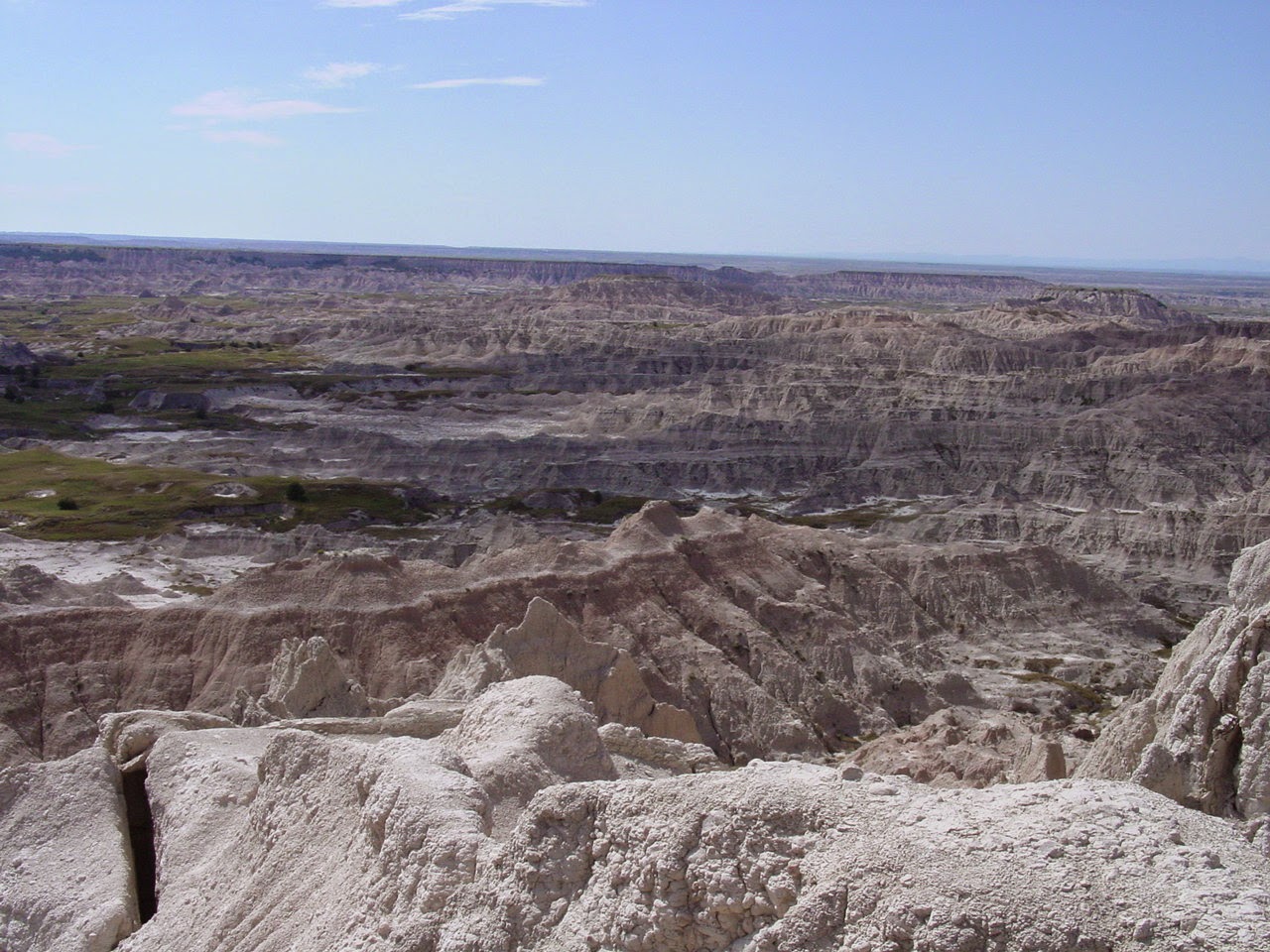
Why the Badlands?  Imagine you were a settler in the 1800s and were moving your family out west complete with two covered wagons, the mules, etc. and, after following miles of flat plains (assuming you also made it over the Smokey Mountains) you come upon this:

Try getting that wagon over this, padnah!
Bill Huth was right.  It is an amazing landscape.  It was formed 65 million years ago when the earth was warmer than it is now and the Gulf of Mexico actually flooded the central U.S. all the way to Canada.  It is full of sea fossils.  The scientists have identified the different layers of fossil life that changes the hues in the landscape as shown below.
While most of the area looks like the photos above, there is an expanse of prairie and there is much wildlife on the prairies.  Lib took this photo of some Big Horn sheep that walked past Fiona.
Plus there are plenty of prairie dogs around and even Buffalo (we didn't see any Buffalo but Wall Drug will sell you a Buffalo Burger).
We made it home after a stop in Rapid City at the Wal-Mart where we bought some provisions and I got a much needed hair cut!

Below are some photos of the Badlands you may enjoy.  Signing off and disappearing into "no wifi/cellphone land."
September 1, 2014 Labor Day

We woke up during the night and decided we would stay in Estes Park one more day to avoid the mass exodus of the Labor Day crowds from Estes Park.  There are only two roads down the mountain and we were worried about being in bumper to bumper traffic.  But, we changed our minds when, after breakfast, we saw that no one was leaving the park.  We figured they were going to wait as long as they could and enjoy their last vacation day.  So, we abruptly changed our plans.  It was a good idea.  We had little traffic down the mountain and enjoyed the scenery.  
 Leaving the Rocky Mountains National Park

There is a creek that runs alongside the road.  Last year they had terrific flooding and parts of the road were washed out.  My favorite sign thus far read: “In case of flooding, climb to higher ground.”  OK, we will keep that in mind!

We had over 300 miles to travel to Hill City, SD and Mount Rushmore.  We went north up I-25 through Colorado Springs and into Wyoming.  Each state has been very different.  We were now entering a state into which neither of us had traveled.  We came to Colorado a few times for skiing when we were in our 30s and 40s.  Wyoming was wide-open; miles of plains.  While Kansas seemed to be almost all row crops, cattle dominated Colorado and now Wyoming was just grasslands.  Lib asked: “Where are the people?” 

Then we saw what we used to dread when crossing the Gulf in our sailboat: a huge thunderstorm on the horizon.  Just as we tried to do when sailing, we tried to determine the direction the storm was moving.  Joy Greer could spot them miles ahead and Todd and I would try to determine the direction. Though it was moving to the east, it looked as though it would definitely hit us.  It did.  But, it was very different than being at sea.  We didn't have to put on our foul weather gear, reduce sail, and get out the harnesses to keep ourselves from going overboard.  Fiona just chugged along pulling Cream Puff  (Thanks to Missie for teaching me how to spell cream!) northeast toward South Dakota.  We did drive through an area of ice which was the result of a pretty good hail storm.  We had just missed the hail storm and this was a good thing.  Cream Puff’s shell is pretty tough but it is aluminum and it doesn’t like large hail.
 Wyoming Storm
Later in the day we moved into South Dakota and into the Black Hills.  From the flat prairies the hills appear to be black on the horizon.  We got to the Mount Rushmore KOA about 4pm.  We are very close to the Mount Rushmore Memorial but no cellphone service and no wifi!  We are on the other side of a granite mountain from Rapid City.  Thank goodness the satellite dish works and we can watch to see what middle eastern tribal group we are going to war with next.

A good night's sleep and early to rise to go see the Presidents on the mountain just above us.  A good Labor Day on the road.  If you have to drive on a busy holiday, I recommend remote southwestern South Dakota.

September 2, 2014  Mount Rushmore and the Crazy Horse Monument

One thing we've learned about RV folk is that they often come over to meet you once you hook up at the campsite.  After a few comments about "your rig" (that is RV talk for the kind of vehicle you are in), they often get into a banter of one-upsmanship about who's seen the most tourist attractions.  Randy, U.S. Army retired, asked: "Ya seen the Wall Drug Store yet?"  No, but I've heard of it from some Pensacola friends, the Teaseleys.  "Probably ain't been to tha Corn Palace, huh?"  Nope and never heard of that one.  I learned this is a place where the walls are made of corn cobs and they have to replace them all once a year.   Decided to pass on this one.

But, the bantering often leads to places you should go.  We learned about the Crazy Horse Memorial.  So we decided to go there after we went to Mount Rushmore.

The sculptures on Mt. Rushmore (Rushmore Mountain was named after a New York attorney years before it was chosen as the sculpture site) were first proposed by a historian in the State Department of History in South Dakota.  His idea was to glorify some of the western heroes and he envisioned Lewis and Clark and Chief Red Cloud.  But, when Gutzon Borglum, the sculptor, was approached to do the job, he thought it should be a memorial to the four presidents: Washington, Jefferson, Roosevelt and Lincoln.  It took 14 years to complete.  It was started in 1927 and finished in 1941.  There were intentions on doing more but WWII cut the funds which were already 100% above projected costs.  The total cost was $1,000,000.  Can you imagine the cost of doing a 14 year project today?  I think you would hit $1million by Tuesday am.
I used my time machine to go back to Mt. Rushmore before the carving began.  You can't get the time machines anymore...QVC sold out.

And fourteen years later!

It is very inspiring and produces a patriotic feeling.  They have a night show that we attended as well. 
There are several scenic overlooks on the drive up the mountain.  At one stop you can see a profile of George W.  Also, this is the place where they filmed North by Northwest. (Hollywood is always present no matter where you go). We will watch that movie as soon as we can get wifi and boot up Netflix.
One of the exhibits at the Memorial describes how they sculpted the mountain.  They built models and then used a ratio of 1:12 from the model to the mountain.  
Models used to transfer measurements to the mountain

And, of course, we requested another visitor carrying camera equipment, etc. to take our obligatory photo!
Elderly Couple seen asking for Coupons on Mt. Rushmore

Next we decided to go to the Crazy Horse Memorial.  This is going to be a much larger sculpture than the Rushmore figures.  Crazy Horse was a Sioux warrior from the Lakota tribe who did not declare war against the white man until the white man broke the 1868 treaty allowing the Sioux to have the Black Hills.  Seems like we gave the Indians land to the west until we decided we wanted it.  He was stabbed to death while in custody at age 34.  He made a statement that the only promise the white man kept was when they said "We will take your lands."
Tribal chiefs approached a sculptor, in the 40’s , after Rushmore had been completed, and asked that he sculpt a monument to the Indian leaders. The sculptor, Korczak Ziolkowski, had worked on Mt. Rushmore. This has been a private undertaking since the 40s. Korczak and his wife had 10 children and most are still involved in the project.  It is all based upon private donations. Several hundred, if not thousand, people visit daily.  The photos below show what the finished work will look like and where it stands today.  


Thats right!  Only his face is finished but much of the stone is now ready for finish work.

They have an Indian history museum and we were both fascinated.  Libbo taught on an Indian reservation in Arizona for three years so she is very sensitive to the Indian issues....EXCEPT for the first year when she told her kindergarten summer class of Apaches, Navajos, and Pimas to "Quit acting like a bunch of wild Indians!"  This was not politically correct but we didn't have PC in the early 70s.  

The museum had a number of artifacts from The Battle of Little Bighorn.  We are going to that battlefield next on our tour.   We will send pictures of buttons and bullets.

Another very busy day. Tomorrow, we go to the Bad Lands!